As a proud lawn owner, you have probably been advised to scarify your lawn at some point. And that is certainly good advice—if done correctly. In this blog, we walk through the key questions of scarifying—what, why, and when—and explain exactly how to do it.
What exactly Is scarifying?
Scarifying is a type of vertical mowing that removes moss and undecomposed organic material that suffocates the soil. By removing this top layer, the grass gets the chance to grow again. After scarifying, your lawn may look like a battlefield, but don’t worry—within a few weeks fresh new grass blades will start to appear.

Why is scarifying so important?
Grass needs space to grow. Unfortunately, grass plants in an average lawn are not the only ones competing for that space. Moss often takes over, especially in shady areas. Together with leftover mowing debris, it forms what is known as a thatch layer on the lawn, which can eventually suffocate the grass completely. Before you know it, moss and weeds take over and a beautiful dense lawn becomes a distant dream. By scarifying, you ensure that grass once again becomes dominant in your lawn.
When should you—or should you not—scarify?
A recurring issue
Unfortunately, scarifying once is not enough. Especially in winter, when there is little sunlight and moisture remains on the ground for long periods, moss can develop rapidly. In most cases, scarifying becomes an annual task. If there is a noticeable amount of moss in the lawn, a second treatment may be required. If the grass is growing well and there is no thatch layer, you can safely skip scarifying for a year.
Always scarify before the growing season
Scarifying is quite an intensive treatment for both the soil and the grass. That is why it is important that the grass has time to recover quickly afterward. March and April are generally the best months to scarify. If a second treatment is needed, it is best done in September or October. There are also a few important conditions to keep in mind:
• de bodem moet voldoende warm zijn, idealiter > 10°C;
• During extreme heat or drought, it is better to postpone the task.
• Avoid periods with heavy rainfall or intense sunshine.
A new lawn? Wait a while!
Grass needs enough time to root and grow before it can handle an intensive treatment such as scarifying. Therefore, wait at least two years—and preferably three years—before scarifying a newly laid lawn.

How to scarify
Manual or by machine
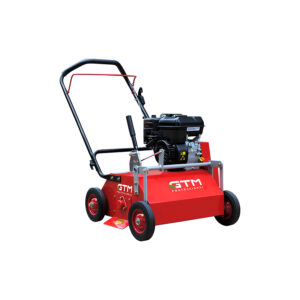
There are several ways to scarify. For small lawns, a scarifying rake can be useful. These are available in fully manual versions or with rolling mechanisms. Because manual scarifying can be quite physically demanding, a scarifying machine is usually preferred for larger lawns. A scarifier is equipped with sharp blades or flails that remove the thatch layer from the grass.
Before and after
To help your lawn recover properly, here are the most important points to consider before, during, and after scarifying.
Preparation:
• Make sure the grass is slightly moist.
• Mow the lawn to a height of 2 to 3 cm and remove the clippings.
• Do you have a robotic mower? Ensure the guide wires are safely buried so they cannot be damaged during scarifying.
Scarifying:
• Set the blades of the scarifying machine to the correct depth. In principle, you do not need to go deeper than 5 mm.
• Scarify in two directions: first lengthwise, then crosswise.
• If your scarifier does not have a collection box, rake dead moss and loose material from the lawn manually. This can also be done with a good lawn mower with a collection bag.
Aftercare:
• Water the lawn with rainwater.
• Reseed any bare patches.
• Provide additional nutrients by fertilizing the lawn. If necessary, add lime or iron sulfate to optimize the soil’s acidity level.